By Jiangnan Chengxin Refrigeration
Concept illustration — not a fabrication drawing or factory photograph.
An electric sliding cold room door RFQ should describe the operating sequence and the electrical responsibilities, as well as the opening dimensions. Specify who or what requests opening, what should happen during passage and closing, and who supplies, connects and commissions each part of the system.
“Automatic door with sensor” is not a complete control specification. A clear functional record gives the supplier a basis for an offer and gives the installer a basis for the agreed handover checks.
Start with the actual traffic
Describe the people, trolleys or vehicles using the entrance. Include the approach direction, expected usage, loaded item dimensions and situations where traffic may stop near the doorway. Mark nearby doors, intersections and staging areas on the layout.
Explain whether an operator normally requests each opening or whether detection is being considered. Identify any process that requires the door to stay open for a supervised period. These are operating requirements to review; they are not a reason to assume a particular sensor is suitable.
For the available product category, see the electric sliding cold room door page. Have the supplier identify the exact drive, controls and accessories proposed for the project.
Write the sequence before choosing devices
Opening requests
State where opening requests originate: for example, an operator station, a vehicle detection arrangement or a signal from another system. Give each proposed input an ID and location. Ask the supplier which request methods it supports and what additional equipment they need.
Passage and closing
Describe the intended closing mode and any authorised hold-open mode. Ask how conflicting inputs are handled and how the proposed system recognises the conditions needed for the next movement. The supplier and responsible designer should confirm the protective functions appropriate to the installation.
Faults and power interruption
Record the required response to loss of supply and the proposed means of manual operation or release. Ask how normal operation is restored and who may perform that task. Do not assume that “manual release” describes the same mechanism or operating procedure on every assembly.
Use a functional RFQ table
The buyer can describe the required outcome in plain language. The supplier should return a proposed solution and identify any requirement that remains unresolved.
| Function | Buyer requirement | Supplier response to request |
|---|---|---|
| Opening command | User or system; location; approach | Proposed input device and interface |
| Closing mode | Expected operating sequence | Supported mode and adjustable settings |
| Presence or obstruction response | Traffic conditions to assess | Proposed protective functions and limitations |
| Hold-open request | Who is authorised and when | Control method and return to normal mode |
| External system link | Required signal and its purpose | Interface specification and responsible integrator |
| Power interruption | Required access arrangement | Actual manual operation and restoration procedure |
| Indication and fault reporting | Information needed by operators | Included indicators or outputs |
Activation and protection are separate questions. A device that requests opening should not be assumed to provide every protective function required during movement. Ask for both to be described in the proposal.
Define the electrical boundary
Provide the available electrical supply as confirmed by the site's electrical designer. Include the connection location and the conditions around controllers and devices, such as temperature, cleaning exposure or vehicle impact risk. Country alone is not an electrical specification.
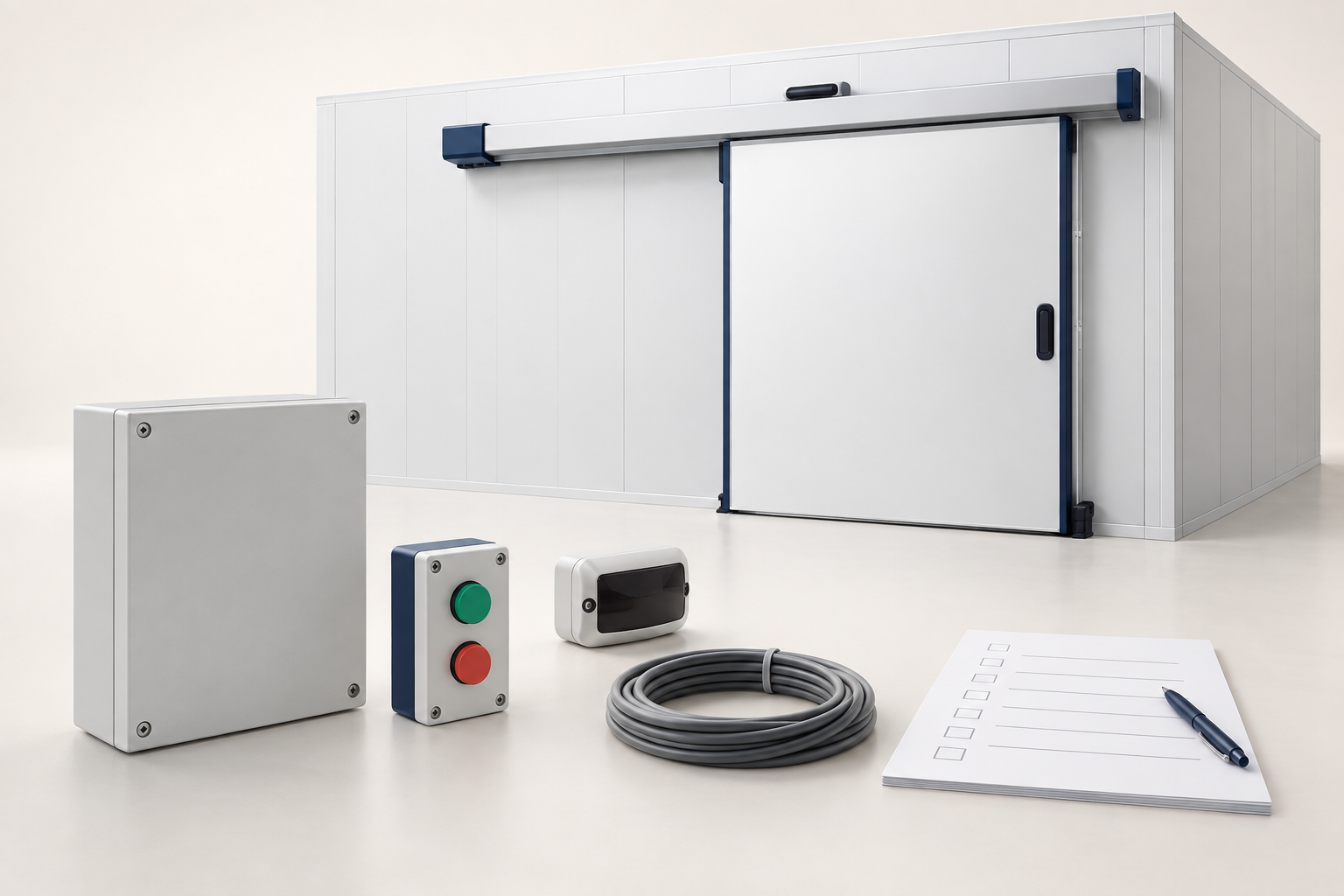
Request a component and connection schedule. It should distinguish the drive, controller, proposed sensors, indicators and any door heating. Ask whether connection cables, flexible cable arrangements, local controls and installation accessories are included.
Record who provides the site supply, circuit protection, isolation, cable routes and final connections. Ask the supplier for the installation documents applicable to its offered equipment. This procurement record is not a wiring diagram; installation and electrical checks belong to the qualified parties appointed for the project.
Keep mechanical interfaces in the same review
The selected powered assembly still needs a confirmed clear passage, adequate travel space and the specified support. Show the drive and control equipment on the coordinated drawing so they do not conflict with the door's movement or maintenance access.
Confirm the wall or cold room panel construction, finished floor detail and any proposed threshold. Allocate responsibility for supports and fixing surfaces. Electrical approval should not release a door whose mechanical interfaces remain undecided.
If powered operation is not yet justified by the traffic description, request a comparison with a manual sliding door using the same passage and environment. Compare the scope and operating needs rather than assuming automatic operation is always the better purchase.
Agree commissioning evidence before ordering
List the agreed checks and who will perform and witness them. The record should identify the installed assembly, approved drawing, control configuration and any outstanding items.
Ask for the agreed opening and closing sequence to be demonstrated together with the specified controls, protective functions and manual operating arrangements. These checks must use the manufacturer's instructions and the responsible specialist's method. Do not improvise obstacle tests or disable devices to complete a demonstration.
Request operator instructions and identification of replaceable components. Record who can change settings after handover and how changes will be documented. A demonstration of the motor alone does not settle the full operating scope.
Send an RFQ with a defined operating sequence
Send Jiangnan Chengxin Cold Room Factory the door dimensions, room and surrounding conditions, traffic description, layout, confirmed supply information and functional RFQ table. State which external systems must interface with the door and who coordinates the site installation.
Use the existing quotation contact page and its contact details to share the requirements. Request a proposal listing included controls, exclusions, installation responsibilities and the documents required for final approval.